
Every piece of ductile iron starts with a single chemical decision: how do you convince the carbon in molten iron to form round graphite instead of sharp flakes? The answer is magnesium, delivered through a carefully engineered alloy called magnesium ferrosilicon, or MgFeSi. Understanding how this alloy works, which grade to choose, and how to handle it correctly is the difference between a clean casting and a rejected one.
What MgFeSi Does and Why It Matters
In ordinary grey iron, graphite grows as long, interconnected flakes. Those flakes act like tiny stress risers, limiting strength and ductility. When magnesium is introduced to the melt, it changes the way graphite grows. Instead of flakes, the graphite forms as discrete, round spheres called nodules. More nodules, rounder nodules, and higher nodularity all translate directly into better tensile strength, yield strength, and elongation in the finished casting.
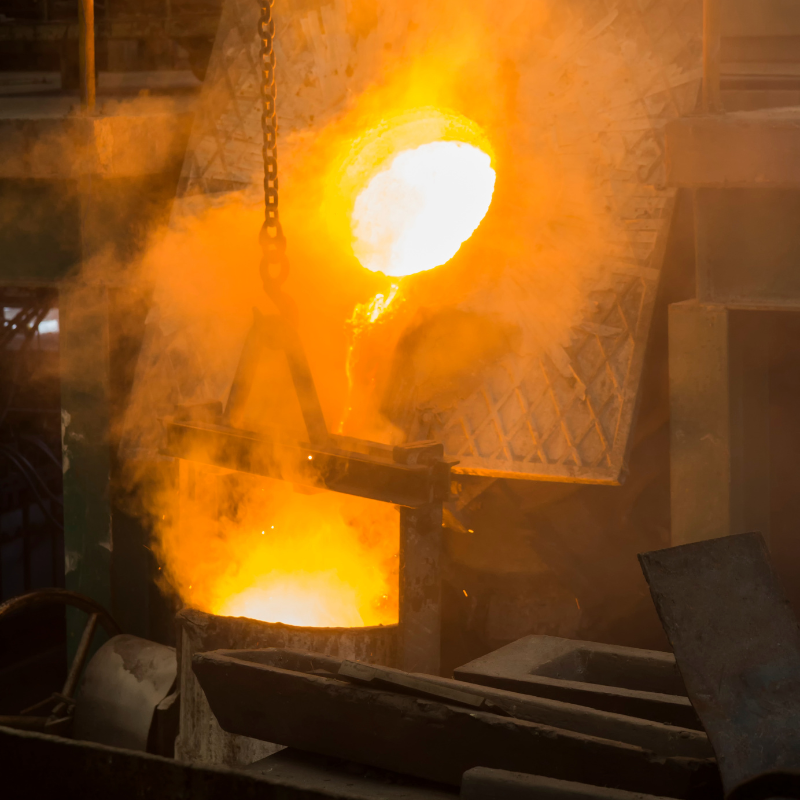
The challenge is that magnesium has a boiling point of only 2174°F (1190°C), at least 392° (200°C) below typical iron casting temperatures. You cannot simply add raw magnesium to a ladle. Instead, magnesium is bonded into a ferrosilicon carrier to create MgFeSi, which releases the magnesium in a controlled way when it contacts the iron.
Who Produces It
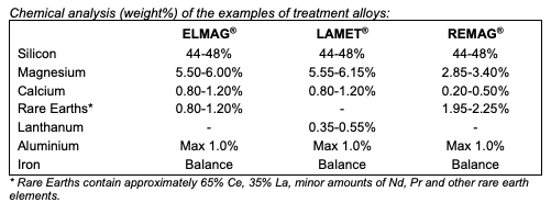
Elkem is one of the world’s leading producers of MgFeSi nodulizers (spelled nodulisers outside the USA), with manufacturing plants in Norway, Canada, China, and India positioned close to the major casting regions they serve. Their product line includes three primary nodulizer families: ELMAG, LAMET, and REMAG.
ELMAG is the core workhorse product, a 44–48% silicon-based alloy available in close to 100 different chemistries. It carries 5.55–6.0% magnesium and is designed for the broadest range of foundry conditions. REMAG is engineered for thin-section ductile iron, where chill and degenerative graphite are constant concerns. It runs a lower magnesium level of 2.85–3.40% but a higher rare earth content of 1.95–2.25%, which promotes high nodule counts with less reaction violence. LAMET comes in two dedicated product lines, one specifically formulated for in-mold treatment and the other for ladle treatment and either is used in applications where shrinkage porosity is a risk. It replaces conventional mixed rare earths with lanthanum at 0.35–0.55%, reducing slag-promoting elements and lowering shrinkage tendency:
When and Where Treatment Happens
For the ladle products, treatment happens at the ladle, between the furnace tap and the mold. In a typical production foundry, iron is tapped from the furnace at 2,600–2,620°F (1,427 – 1,438 C) and poured at the mold between 2,400–2,520°F. The MgFeSi is placed in the ladle first, then covered with steel punching’s and Topseed 1010 using the sandwich method. iron then flows on top of the alloy, the reaction occurs ideally when the ladle is 1/3 to ½ full, and the treated iron is ready to pour1.
Addition rates vary based on the sulfur level of the base iron, treatment temperature, and ladle design. Across the industry, rates range from 0.9% to 2.5% by weight. Base iron sulfur content plays a large role because magnesium reacts with sulfur before it does anything useful for graphite shape. A 2023 study by Trevor Beach and colleagues at Betz Industries together with Elkem Materials and Carpenter Brothers was presented at the Keith Millis Symposium. In it, the median sulfur level across 12 trial heats was just 0.009%, which reflects well-managed base iron. Keeping sulfur low means more of your magnesium goes toward forming nodules rather than being consumed by desulfurization.
How to Get the Most Out of Your Alloy
A few process variables have an outsized effect on magnesium recovery.
Ladle geometry matters. A height-to-diameter ratio of 2:1 is ideal. A deeper ladle means more iron stacks above the alloy before the reaction begins, which captures more magnesium vapor before it can escape.
Alloy sizing matters just as much. A particle size around ½ inch is the sweet spot for most operations. Material crushed too large takes too long to dissolve and can float to the surface before reacting. Material crushed too fine floats into the dross and also fails to react fully. The ½-inch range provides enough surface area to dissolve quickly while staying submerged long enough to do its job. This sizing consideration becomes especially critical for treatment batches under 1,000 lbs.
Covering the alloy before the ladle fills gives you additional control. Placing a layer of steel punchings, or a 50% or 75% FeSi alloy, and Topseed 1010 on top of the MgFeSi before tapping delays the reaction just long enough to build a proper head of iron above the alloy. The use of cover steel and Topseed 1010 help to delay & reduce the volatility of the reaction and improve recoveries of the MgFeSi resulting in less material used.
Treatment temperature should be kept as consistent as possible from heat to heat. Lower temperatures improve magnesium yield, and well-insulated ladles using lower-alumina refractories and insulating paper help reduce heat loss between treatment and pouring.
Inoculation: The Companion Step
Treating with MgFeSi is not the finish line. Inoculation follows treatment to promote graphite nucleation and prevent the iron from going hard or forming unwanted graphite shapes before it solidifies. Inoculants are the material that prevents excess undercooling, the rapid drop in temperature during solidification that, left unchecked, causes carbides or degenerate graphite shapes instead of the round nodules you want. The inoculant you select matters as much as the nodulizer.
The Trevor Beach study tested 12 combinations of MgFeSi and inoculant across section sizes ranging from 1 inch to 10 inches. Two combinations stood out clearly:
- Sample 8, using an alloy with approximately 6% magnesium combined with a bismuth-containing inoculant, produced the best overall nodule count, nodularity, and mechanical properties.
- Sample 9, using an alloy with 3.7% magnesium combined with a barium-containing inoculant, was equally strong.
The study concluded that barium is a known inoculation element that resists fade, meaning it stays active longer between treatment and pouring. Bismuth promotes graphite nucleation directly, increasing the number of nodules that form. Together, these findings confirm that the right MgFeSi grade and the right inoculant are a package decision, not two separate ones.
Putting It Together
Producing consistent ductile iron is a systems problem. The nodulizer grade, the inoculant chemistry, the ladle geometry, the alloy sizing, the cover material, and the treatment temperature all interact. There is no single universal recipe. The 2023 Keith Millis study reinforces this clearly: most of the twelve combinations tested were inadequate for mechanical properties in thicker sections, but the right pairings delivered excellent results. Testing multiple combinations in your specific process is the only way to find what works in your foundry.
The good news is that with a structured approach, the right alloy partners, and disciplined process control, the path to rounder nodules, higher nodule counts, and better castings is well mapped.
Ready to Optimize Your Nodulizer Program?
Carpenter Brothers, Inc. is your North American source for Elkem’s ELMAG, LAMET, and REMAG nodulizers, along with the metallurgical expertise to help you match the right grade to your process. Whether you are troubleshooting low nodularity, high addition rates, low recovery percentage (70% or less) or section sensitivity in heavy castings, our team is ready to help.
Contact Carpenter Brothers, Inc.
7100 W. Donges Bay Rd., Mequon, WI 53092
Phone: (800) 558-9244