
Every casting starts the same way, with foundry ladles. Whether it is iron at 2,600°F, steel at 3,200°F, or aluminum at 1,300°F, someone or something has to safely pick up that liquid metal and put it exactly where it needs to go. That job falls to the ladle, one of the most underappreciated pieces of equipment in any foundry. For manufacturing engineers and buyers managing daily pours, understanding ladles options, materials, and suppliers can directly affect yield, safety, and cost.
Why Ladles Matter More Than You Think
Heat loss is money lost. A significant temperature drop between the furnace and the mold risks a short pour, a cold shut defect, or a scrapped casting. In a mid-volume iron foundry running hundreds of pours per shift, even a 50°F variance can cascade into quality rejects that eat into margin fast. The right ladle liner can meaningfully reduce heat loss to the atmosphere and to the ladle body itself, keeping metal closer to target temperature from tap to pour.
Beyond temperature, foundry ladles take a beating. Thermal cycling, erosion from slag, and the physical stress of being handled by workers or robots demand materials that hold up across multiple heats without cracking, sticking to metal, or requiring constant recoating.
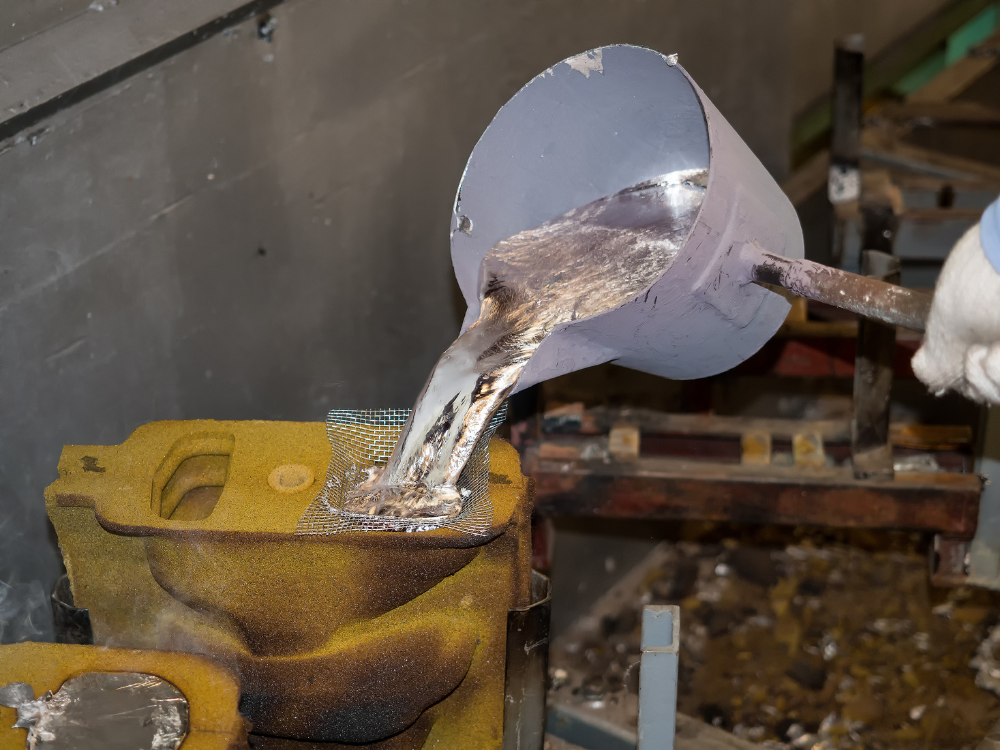
Hand Pour, Robot, or Transfer Furnace: Three Very Different Jobs
Not all foundry ladles are created equal, and the application dictates the design. Hand-poured ladles are the workhorses of smaller foundries and short-run shops. Workers carry or tilt them manually, so weight is critical. A lighter ladle means less fatigue, more uniform pours, faster cycle times, and fewer injuries. These are typically shank ladles with fiber-based ceramic liners sized from just a few pounds of capacity up to several hundred.
Robotic pouring has grown significantly as foundries push toward automation and improved pour quality. Robots don’t get tired, yet they demand dimensional consistency. A ladle liner that varies even slightly in its outer diameter can cause fit problems in the pouring shank or misalignment on the pour axis. Repeatability in the liner’s OD is non-negotiable here.
Transfer ladles mounted to large furnaces operate at a different scale entirely. These are custom-built units holding hundreds or even thousands of pounds of steel, iron, or non-ferrous alloy. They are engineered specifically for the furnace they serve, often requiring proprietary refractory mixes rated for sustained high-temperature exposure across extended campaigns.
Ferrous vs. Non-Ferrous: The Temperature Divide
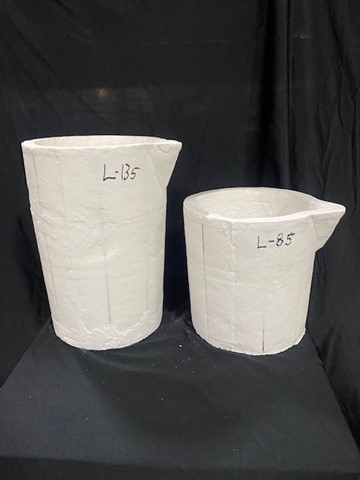
Steel and iron foundries operate at temperatures that push most refractory materials to their limits. Steel can exceed 2,900°F at tap. Iron typically runs between 2,400°F and 2,700°F. At these ranges, the chemistry of the liner matters as much as the thermal insulation. MgO-based (magnesia) and Zirconia mixes are preferred for steel applications because of their resistance to the corrosive nature of molten steel and their exceptionally high melting point.
Non-ferrous metals, including aluminum, copper, and brass, run at significantly lower temperatures, typically 1,200°F to 2,000°F depending on the alloy. These applications allow for lighter, more insulating fiber materials that excel at keeping temperatures stable without the thermal mass of heavier refractory alternatives.
Supplier Spotlight
Several established suppliers serve the full spectrum of foundry ladles.
Morgan Advanced Materials, founded in 1856 and headquartered in the UK, is among the oldest and most globally distributed foundry product manufacturers. Morgan’s hot pour ladles and ladle liners use vacuum-formed, rigid ceramic fiber insulation that is reported to be 33% more efficient than non-bonded fiber, reducing heat flow and improving metal temperature consistency. Hot pour hand ladles are offered in 20 lb and 28 lb capacities, while bottom-pour versions come in 2, 4, and 6 lb sizes. For aluminum, Alfibond® liners provide alumiphobic resistance to molten metal attack, helping preserve alloy purity and extend ladle life.
Exochem by Thermotec offers ladle liners engineered from advanced refractory materials in two primary mix formulations. Their TL-S is a silica-based mix. The MgO Based Mix (MSHT) is a high-purity formulation suited for the corrosive demands of molten steel. It offers excellent thermal shock resistance. Key advantages include wear resistance, easy installation due to lightweight construction, and custom sizing to integrate into existing ladle designs without major modifications. Thermotec specifically highlights the ability of their liners to lower tap temperatures and extend pouring durations, which translates directly to better alloy yield and fewer scrapped heats.
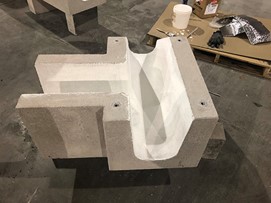
United Refractories Company offers custom precast refractory shapes. Precast shapes provide faster installation than a cast-in-place refractory but still provide a much longer life than the vacuum-formed liners. Applicable for steel and iron to non-ferrous. Built to tolerate abrasion, mechanical abuse, and extreme heat, Custom Precast Shapesoffer tight dimensional tolerances and custom anchoring to maximize the life of the shape and extend your plant’s refractory life. United Refractories also supplies a wide range of castable refractory for lining ladles and patching in-house.
What to Look for When Specifying a Ladle
For engineers and buyers evaluating options, a few key criteria should drive the decision. First, match the liner material to the metal. MgO or Zirconia for steel and high-iron applications, fiber ceramic for non-ferrous and lighter ferrous work. Second, confirm dimensional tolerances, especially for robotic applications where fit consistency determines pour accuracy. Third, factor in reuse life. A liner that lasts 20 heats versus 10 heats at a comparable price point cuts your cost per heat in half. Fourth, consider whether preheating is required. Ladles that need torch-drying before each use add labor and cycle time that compounds across shifts.
Carpenter Brothers, Inc. (CBI), founded in 1917 in Milwaukee, brings over a century of foundry supply experience. Carpenter Brothers, Inc. offers vacuum-formed ceramic fiber ladles, ladle liners, and fiber skimmers typically used in iron and steel melting. We also provide metal hand ladles, automatic dip ladles, and metal skimmers primarily used for nonferrous applications. CBI’s value is not just in the products we carry, but in the technical service our team delivers, many of whom are former foundry operators. For buyers managing a complex procurement environment across melting, pouring, and material handling, CBI functions as a single-source partner capable of supporting everything from transporting ladles to robotic integration.