
Accurate foundry temperature measurement is the backbone of consistent metal quality. Whether you’re tapping a cupola, treating a ladle, or pouring investment castings, knowing the exact temperature of molten metal in real time determines everything from mechanical properties to yield. For decades, foundries and steel mills have relied on Heraeus Electro-Nite, “HEN” for immersion thermocouples and instrumentation that combine speed, durability, and laboratory-grade accuracy on the shop floor.
The Everyday Workhorse, XT Multiple-Immersion Thermocouples
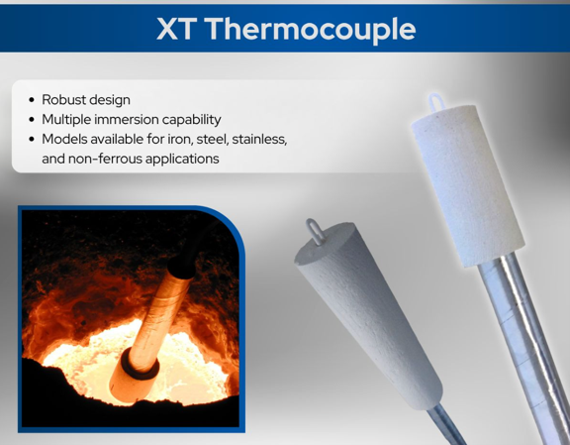
For most foundry temperature measurement operations — induction furnaces, fuel-fired crucible furnaces, cupola forehearths, and ladles where heavy slag cover isn’t a factor — the XT thermocouple is the industry’s go-to tool. HEN’s original invention of the multiple-immersion thermocouple was a breakthrough because it let metallurgists take several readings from a single lance instead of discarding a sensor after every dip, dramatically lowering the per-reading cost.
The XT2 features a patented quartz U-bend embedded in an insulating refractory cement, wrapped in a refractory fiber sheath that prevents splashing and minimizes cold-junction heating across repeated immersions. That engineering translates directly into consistency in that the XT delivers accurate readings over a rapid series of three or four dips without significant internal heat build-up. For more demanding environments like stainless steel, corrosive iron alloys, or unusually high tapping temperatures, the premium XT4 model adds a corrosion-resistant coating for extended performance in high-alloy steels and nonferrous metals.
On accuracy, the numbers speak for themselves: the XT’s platinum-based thermocouple element is NIST-traceable and rated better than 0.25% of the measured value, covering a working range of 900°F to 3300°F.
Going Technical: The IF Thermocouple and Close-In Measurement
Where the conversation gets more technical is with the IF (In-Furnace) thermocouple. Unlike the XT, which immerses its full sheathed assembly, the IF uses only a 1½” quartz thermocouple loop that goes directly into the metal. This design is purpose-built for repeated close-in measurements in small vessels, and it’s especially valuable in high-purity alloy work — think investment casting — where avoiding melt contamination is critical.
Because only the quartz loop touches the metal, most foundries pair the IF with a ceramic fiber or metal shield on the lance to protect the connector and lance-holder tip, minimizing intermediate junction heating and extending contact block life. A related variant, the NSLIF, builds on the same proven IF technology with added ceramic tube protection, purpose-designed for Vacuum Induction Melting (VIM) applications where non-splash operator protection is mandatory.
The Economical Choice: ML Single-Use Lances
For high-volume, single-dip applications for foundry temperature measurement the ML (Positherm) thermocouple is HEN’s least expensive option. Its small-diameter lance design allows easy penetration of molten metal, and the low thermal mass minimizes heat absorption at the hot junction — meaning faster, more representative readings. The quartz loop is mounted using a specially formulated cement resistant to moisture pickup during storage, and the lance body is monolithic ceramic — a more reliable construction than designs relying on plastic bodies or large exposed castable cement surfaces. ML lances are used extensively in EAF, induction, and ladle applications, with an ENT variant available for non-splash environments.
Across all three product lines — XT, IF, and ML — the common thread is HEN’s manufacturing discipline: every wire lot is calibrated to NIST standards, checked by magnification, tested for physical properties, and verified against rigid EMF standards, all under an ISO 9001:2008 quality system with ISO/IEC 17025:2005 calibration lab accreditation. HEN has also transitioned thermocouple manufacturing from the IPTS 1948 to the IPTS 1968 standard, tightening accuracy specification from ±1.5°C to ±1.0°C — a 33% improvement.
Reading the Results: Instrumentation Options
A thermocouple is only half the story — the instrument reading it matters just as much. HEN’s handheld Digilance V (“Digilance 5”) is the flagship unit for day-to-day operations, delivering temperature accuracy better than 1°C (1.8°F), a 5–8 second measurement time, and onboard storage for up to 500 readings, with both standard and optional wireless configurations available.
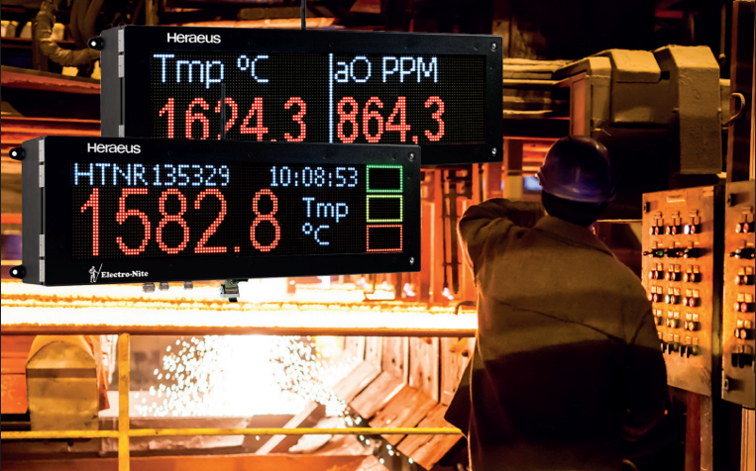
For applications where visibility across the shop floor matters, HEN’s RD252 large-format numerical LED display is purpose-built for exactly that.
RD252 Display
Designed for challenging industrial environments like steel works and foundries, the RD252 uses extra-bright, large LED digits (128×32-pixel RGB LED matrix) that stay clearly legible even from viewing angles as wide as 150°. This makes RD252 ideal for reading results from across a busy melt deck. It communicates with existing Heraeus Electro-Nite instruments over either a hardwired TTY/Ethernet connection or the newer wireless Remote Protocol, and its rugged steel-plate housing carries an IP54 rating with an operating range of -20°C to +60°C (-4°F to 140°F), so it holds up to heat, dust, and moisture on the shop floor. Its plug-in electronics boards, terminals, and power supply also make servicing straightforward, a practical benefit for maintenance teams keeping instrumentation online.
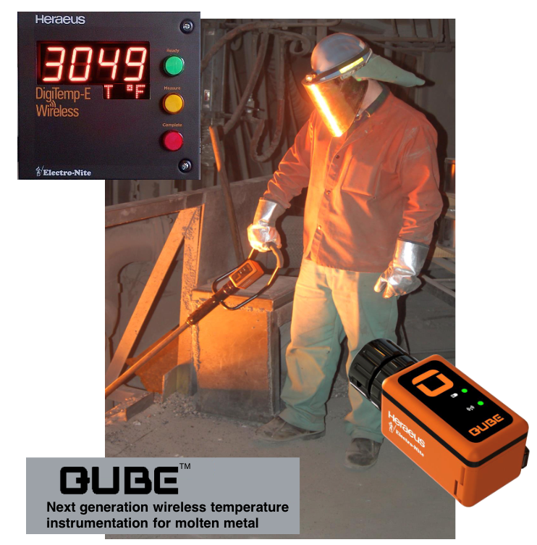
Legacy wall-mounted units continue to be supported as well. The DTE4, a wired-pole instrument with a 2″ display, remote light/buzzer signaling, and full data output (RS232, Ethernet, 4-20mA) remains available, and it also serves as the wireless receiver base station in HEN’s QUBE system.
The most technically advanced option is QUBE, HEN’s wireless instrument system. QUBE eliminates the hardwired connection between the lance and the display by transmitting data wirelessly up to 300 feet from transmitter to receiver, with a lithium-ion rechargeable transmitter battery good for 800–1,000 measurements per charge, automatic power on/shutdown, and simple sub-minute pairing between any transmitter and receiver. Because the temperature signal doesn’t have to travel through a long wire run where resistance, connector wear, and lead-wire error can all introduce inaccuracy.
QUBE offers a meaningful 30% accuracy advantage over hardwired setups, and its receiver can drive remote signal lights, a buzzer, or a large 4″ remote display (AN100E4) for shop-floor visibility.
QUBE Wireless Measurement
Together, the RD252, DTE4, and QUBE give foundries flexible ways to view results — whether at the point of measurement, from across the plant floor, or wirelessly without the constraints of a wired pole.
Choosing the Right Setup
With three thermocouple families and multiple instrument platforms, selecting the right combination for your furnace, alloy, and process depends on immersion frequency, purity requirements, and how your team collects data. Carpenter Brothers is available to help metallurgists and process engineers evaluate these foundry temperature measurement options and match the right Heraeus thermocouple and instrument to your specific foundry application. Reach out today – https://www.carpenterbrothersinc.com/.