
The Element That Makes Stainless, Stainless
Chromium is the defining element that transforms iron into stainless steel. When chromium is added to iron in concentrations exceedingly roughly 10 to 12%, it reacts with oxygen in the surrounding environment to form a thin, self-healing oxide layer on the steel surface. That passive film is what blocks corrosion at the atomic level. Without adequate chromium, stainless steel is simply steel. The metallurgical industry has formally recognized this threshold, defining steels containing more than 10 to 12% chromium as stainless steels. Everything above that number is a question of how much more performance you need, and in what form.
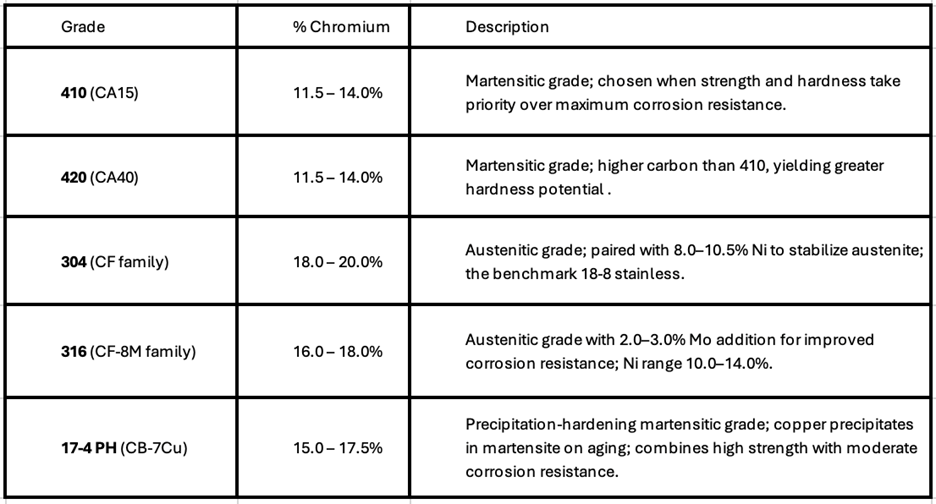
Chromium Content Across Common Cast Stainless Steel Grades
What Changes in Castings
Investment and sand castings introduce a complexity not found in wrought products. Because casting involves solidification from a liquid state, segregation and the formation of secondary phases are real concerns. To counteract cracking during solidification and improve weldability, cast austenitic grades are intentionally modified with slightly elevated chromium content relative to their wrought equivalents. This pushes the microstructure into a duplex territory, introducing 5 to 15% ferrite within what is otherwise an austenite matrix. That small fraction of ferrite matters. It improves resistance to hot cracking and stress-corrosion cracking while reinforcing the alloy’s inherent corrosion resistance.
The carbon content threshold also distinguishes corrosion-resistant from heat-resistant cast grades. Corrosion-resistant castings, which operate in liquid environments, carry lower carbon levels to preserve chromium availability in the matrix. Heat-resistant castings, designed for service above 650°C (1200°F), tolerate higher carbon because mechanical strength under thermal load becomes the governing priority. When you are specifying ferrochromium additions for a casting heat, understanding which side of that carbon-temperature line your product falls on is foundational.
What Is Low Carbon Ferro Chromium?
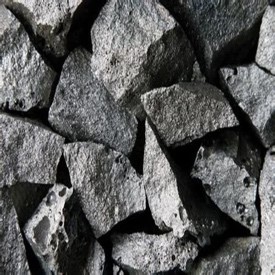
Ferro chromium (FeCr) is the commercial vehicle for delivering chromium into a steel melt. It is produced from metallurgical grade chromite ore and is broadly categorized by carbon content. High carbon FeCr (HC FeCr) contains between 4 and 9% carbon and typically carries 60 to 70% chromium with 1 to 3% silicon. Low carbon FeCr (LC FeCr) holds carbon below 0.5% with a comparable chromium range of 60 to 70%. A medium carbon grade occupies the 0.5 to 4% carbon band and sees use in foundry applications where refining capacity is limited.
Over 80% of the world’s ferro chromium production is consumed by stainless steel manufacturing. The vast majority of that volume is charge chrome, a lower-chromium, higher-silicon variant of HC FeCr primarily produced in South Africa, which feeds large-scale melt shops equipped with argon-oxygen decarburization (AOD) vessels that can burn carbon down after the melt.
It Is Not Just About Production, It Is About What Arrives in the Melt
A common misconception is that HC FeCr and LC FeCr are interchangeable inputs that simply require different downstream processing. The distinction goes deeper than that. HC FeCr is produced by carbothermic reduction, meaning carbon is the reducing agent in a submerged electric arc furnace. That chemistry is efficient and cost-effective, but it locks significant carbon into the alloy. LC FeCr cannot be made by that route. Instead, it is produced through metallothermic reduction processes, specifically the Duplex (Perrin) or Simplex processes, which use silicon rather than carbon as the reducing agent. This is a fundamentally different chemistry that yields a product with less than 0.5% carbon and improved ductility and toughness compared to the HC product.
When you charge HC FeCr into a casting heat without a downstream refining step capable of pulling that carbon out, the carbon travels with the chromium into the melt. In grades where carbon tolerances are tight, such as CF3 (0.03%carbon max) or CF3M, that is not a minor issue. Residual carbon that is not removed will combine with chromium at grain boundaries during cooling and form chromium carbides. Those carbides rob the matrix of the chromium needed to maintain the passive film, creating zones of localized corrosion vulnerability known as sensitization. The effect is especially damaging in austenitic castings exposed to corrosive media.
LC FeCr solves this at the source. By delivering chromium with less than 0.5% carbon, the foundry metallurgist has far greater control over the final chemistry without depending entirely on a melt shop’s ability to decarburize. For investment castings in particular, where melt volumes are smaller and argon oxygen decarburization (AOD) refining is often not in the process chain, specifying LC FeCr is not a premium convenience. It is a process control necessity.
The Practical Decision for Foundry Metallurgists and Buyers
For the metallurgist writing the charge plan for a CF3M investment casting or a CA6NM sand casting, the choice between HC and LC FeCr is a carbon budget question. HC FeCr brings economy and availability, but the carbon it introduces must be accounted for and removed. LC FeCr brings a cleaner chromium addition with a carbon penalty that is measured in hundredths of a percent rather than whole numbers. For buyers sourcing ferro chromium through a distributor, the conversation should be the same one your metallurgist is having. Knowing whether your casting shop has AOD capability, what the carbon ceiling of your target grade is, and how tightly your customer specifications are written determines which product belongs in your inventory.
Distributors like Carpenter Brothers Inc. who understand this decision tree are not simply moving product. They are helping their customers make the right charge calculation before the furnace is even tapped. That kind of informed sourcing is the difference between a heat that meets specification and one that does not.
Carpenter Brothers Inc offers sales and technical assistance on low carbon ferro chromium (LC FeCr). If you are designing a new alloy in stainless steel or seeking help on which version of ferro chrome to use, or to purchase ferro chrome, it’s time to reach out Carpenter Brothers Inc. (https://www.carpenterbrothersinc.com/).