
Foundries today face growing pressure to increase productivity, reduce energy consumption, enhance metallurgical control, and operate with greater environmental responsibility. Otto Junker’s portfolio of medium-frequency coreless induction furnaces and channel-type induction furnaces provides a technologically advanced solution designed to meet these requirements. These systems offer a combination of high-power density, excellent process control, operational flexibility, and low energy consumption, making induction melting an increasingly attractive choice for melt shops seeking both performance and return on investment.
What Is Induction Melting?
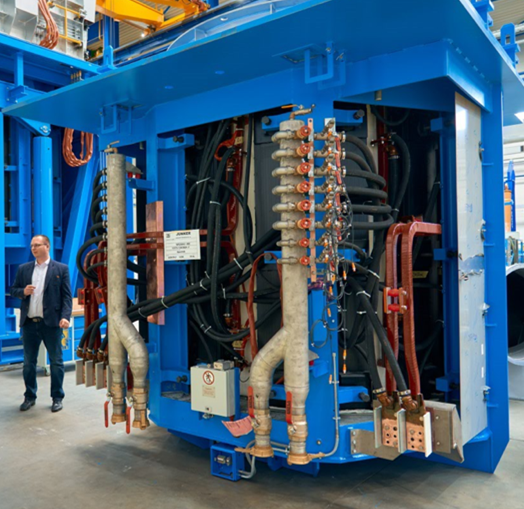
Induction melting is a process in which heat is generated directly inside the metal charge by electromagnetic induction. The principal advantages lie in the direct input of heat into the metal, accompanied by selectively controlled bath movement and a metallurgically neutral melting regime. Because energy is introduced internally rather than transferred from an external combustion source, induction systems offer highly efficient thermal transfer and consistent melting conditions.
Both coreless induction furnaces and channel-type induction furnaces are used in foundry operations. Coreless technology offers universal flexibility for melting diverse metals, while channel furnaces are designed primarily for holding, storing, superheating, and pouring in high-volume, continuous operations.
Why Induction Melting Is Attractive for Foundries
The technical and economic benefits are the foundation of induction melting’s global growth. Induction melting offers close temperature and process control, delivering high analytical accuracy and reproducibility. High analysis accuracy refers to the furnace system’s ability to maintain precise and reproducible chemical composition measurements of the molten metal during melting. The high power‑density design enables rapid melting rates and efficient energy transfer. There is the ability to process a wide range of charge materials supporting flexible, grade-to-grade changeovers, and the furnace can operate with or without a heel, enhancing overall operational versatility.
For metallurgists and process engineers, the ability to manage a selective and controlled bath movement provides enhanced metallurgical consistency, while management teams value high melt availability, easy operation, and maintenance.
Key Economic Advantages of Induction Technology:
• Low energy consumption
• Low melting loss
• Low labor costs via automated melting operation
• Compact design reduces building and installation costs
• Minimum erection time through pre-assembled modules
These benefits support ROI-driven decision-making and reflect directly on foundry throughput, cost-per-ton, and lifecycle equipment efficiency.
How Otto Junker Induction Systems Work
Medium-frequency coreless induction furnaces use a coil through which alternating current generates electromagnetic fields. These fields induce eddy currents in the metal charge, causing rapid heating and melting. The resulting bath movement is managed precisely to support metallurgical quality and homogenization. Otto Junker’s high-power designs include furnaces reaching 25,000 kW power ratings for cast iron melting.
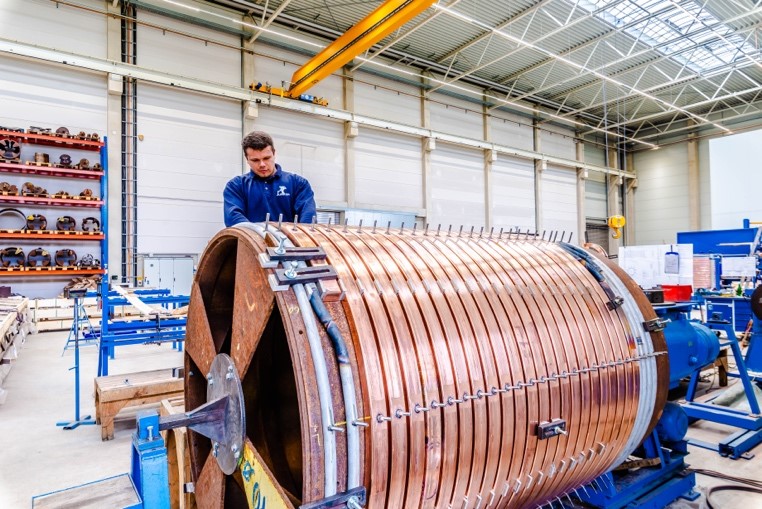
Induction Furnace Construction. Source: Otto Junker
Channel-type induction furnaces incorporate inductors connected to a holding vessel. They are particularly suited to foundries where:
• Large quantities of liquid metal must be stored, superheated, or poured
• Molding lines require a variable but continuous metal supply
• Furnace capacity utilization must be maximized by enabling tapping at any time
• Temperature and composition variations must be equalized
These systems support continuous addition and pouring of molten metal, and their design avoids any need for ladle movement during tapping, since most furnaces are built to tap out in a fixed ladle position.
Energy & emissions are on every foundry’s front burner. Induction heating is an efficient, low‑emission alternative to fuel‑fired systems, reducing fossil‑fuel use while enabling renewable‑powered operation. Its high-power density accelerates melting, and optimized engineering cuts energy consumption and maintenance tied to combustion equipment, delivering steadier throughput without burner fluctuations or refractory-related losses.
Operational Benefits for the Foundry and Induction Technology:
1. Improved Metallurgical Control
Close temperature and process control, high analysis accuracy, and definable bath movement contribute to high-quality and reproducible
2. Flexibility Across Metals and Alloys
Otto Junker designs systems suitable for melting a wide range of metals from aluminum, iron, and steel to magnesium, zinc, cobalt, nickel, silicon, and silver.
3. Enhanced Productivity
High melting rates and uninterrupted metal availability with channel-type systems increase molding line efficiency.
4. Lower Operating Costs
Energy consumption, labor, building, and installation costs are all minimized through Otto Junker’s design philosophy.
5. Sustainability and Emissions Reduction
Induction reduces dependence on fossil fuels and can operate CO2-free when powered by renewable energy.
Otto Junker: Global Expertise and Support
Otto Junker’s century of experience, Technology Center, and worldwide presence underscore their position as a leading global manufacturer of induction melting and thermo-processing systems. Their service portfolio includes melt shop planning, return-on-investment estimates, installation, upgrades, and 24-hour after-sales support (https://www.otto-junker.com/en/).
North American Representation
Carpenter Brothers Inc. is the official North American representative of Otto Junker products and technologies. For foundries seeking improved melt shop efficiency, metallurgical consistency, and long-term ROI, contact Carpenter Brothers Inc. to begin planning your induction melting upgrade (https://www.carpenterbrothersinc.com/).
Metal Casting Products
Carpenter Brothers, Inc. offers a full line of metal casting consumable products. Products that are used in the ferrous, non ferrous, investment casting and die casting industries.
Foundry Equipment
Carpenter Brothers, Inc. offers a complete line of foundry equipment to meet the requirements of the Metal Casting Industry. Founded in 1917, by Everett and Milton Carpenter.
Investment Casting
Carpenter Brothers, Inc. supplies products and equipment used by the investment casting industry daily! We offer sand for every aspect of your process.